Cam Crank Correlation Dual Channel Scope Meter Uk
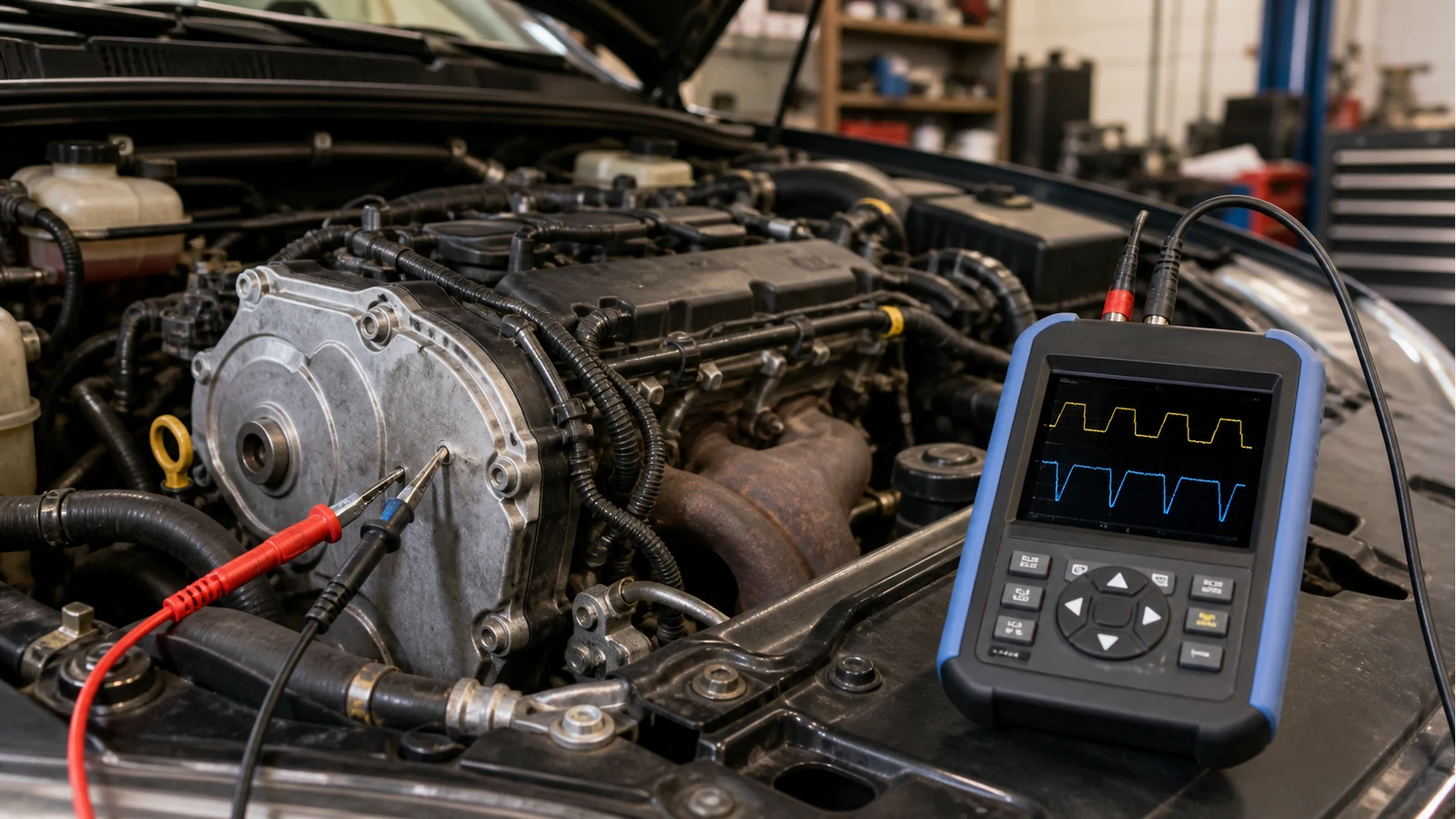
Direct answer: a dual-channel scope meter helps an auto electrician compare cam and crank sensor timing before replacing parts. One channel watches the crank reference, the other watches a cam signal, so the technician can see whether the issue looks like wiring, sensor output, synchronisation or a mechanical timing relationship.
This matters when a vehicle only misbehaves hot, after a road test, or after the customer has already returned once. A fault code can point to a system, but it does not always prove that the sensor itself is bad.
The basic correlation ladder
- Confirm the sensor type and expected safe probing method from service data.
- Use the crank signal as the timing reference on one channel.
- Put the cam signal on the second channel and capture enough time to see a repeatable relationship.
- Compare the pattern around a known crank reference point, then save the waveform as the job record.
- Only then decide whether the next step is wiring, sensor replacement, timing inspection or a higher-channel test.
Snap-on's UK cam/crank correlation note explains the diagnostic idea: a lab scope can compare relationships between multiple engine position sensors. Pico's cam and crank correlation application note likewise describes using crankshaft and camshaft signals together to evaluate correlation.
Where two channels are enough
Two channels are useful when the question is narrow: one crank sensor versus one cam sensor, or one command versus one response. That is a common practical line for mobile work because it can separate “the signal vanished” from “the signal is present but mistimed”.
Two channels are not a full substitute for a guided automotive suite. If the job requires several camshafts, crank, injection, ignition and pressure correlation in one capture, you are in higher-channel territory. Pico's 8-channel automotive oscilloscope page is a useful boundary example of where specialist multi-channel kit starts to make sense.
Stop conditions
Stop before probing ignition primary or secondary circuits unless you have the correct rated probes and procedure. Stop if service data does not identify a safe low-voltage signal point. Stop if the tool manual does not confirm the input and probe ratings for the circuit you plan to touch.
If your actual job is low-voltage cam/crank or CAN-related comparison and the product documentation confirms the needed inputs, a two-channel handheld meter can be a sensible shortlist item. The same-site handheld oscilloscope multimeter product page is relevant only under those conditions.