Electronics Testing Oscilloscope Explained: A UK Buyer's Guide
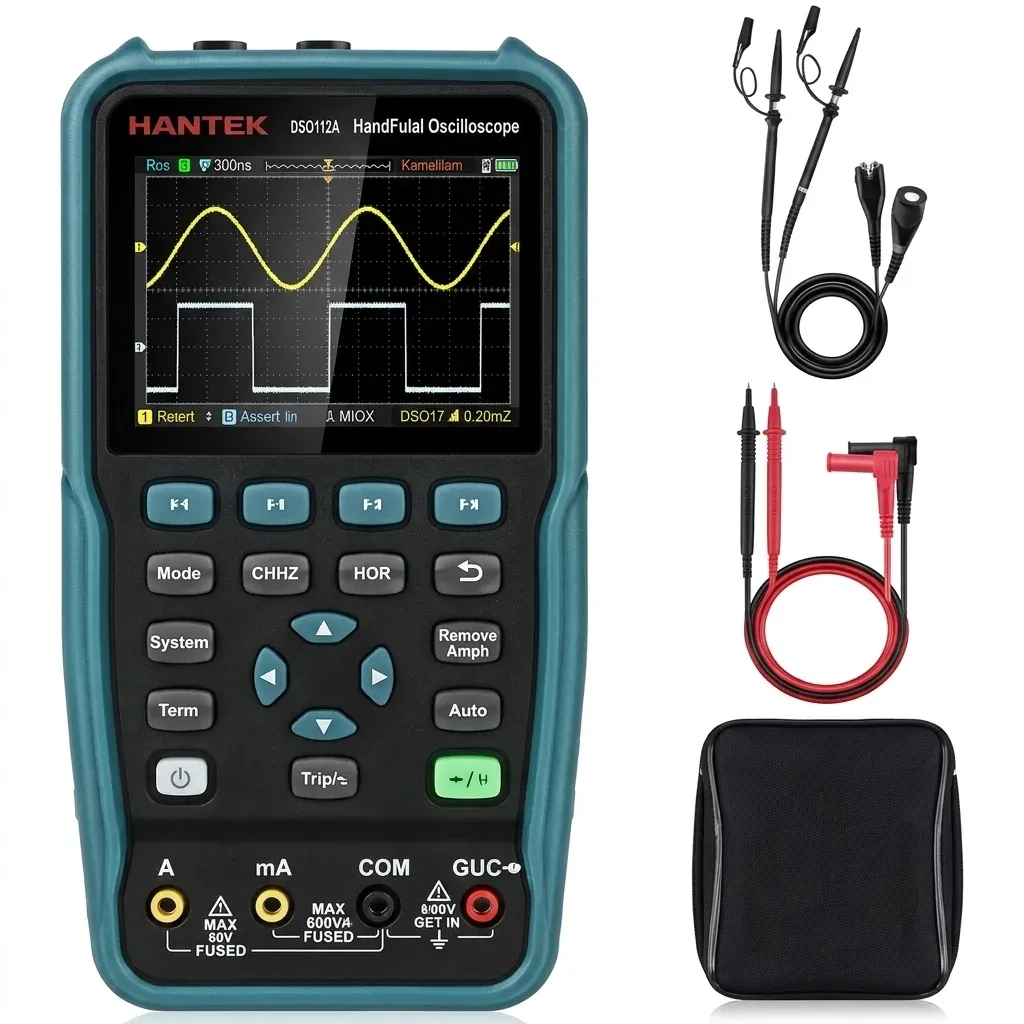
TL;DR: An electronics testing oscilloscope is a graphical diagnostic instrument that displays how electrical voltage changes over time. While a basic multimeter tells you if a circuit is live, an oscilloscope shows the exact shape, timing, and stability of the signal. Based on our testing at MultimeterShop, combining these capabilities into a professional handheld unit is the most efficient way for UK engineers to diagnose intermittent faults and noisy power rails in the field.
When an electronic circuit behaves oddly, a multimeter can tell you that something is wrong, but an electronics testing oscilloscope shows you exactly how it is going wrong. By providing a visual representation of electrical signals, this tool directly answers the search for dynamic faults, especially when you are chasing intermittent issues, unstable signals, noisy power rails, or communication errors in the field.
Furthermore, for UK engineers, maintenance teams, installers, educators, and electronics technicians, choosing the right oscilloscope is less about laboratory prestige and more about practical diagnosis. It needs to be quick to deploy, accurate enough to trust, and portable enough to use where faults actually happen. Consequently, the professional handheld oscilloscope multimeter has become an incredibly useful category, as it seamlessly combines fast electrical checks with comprehensive waveform analysis in one tool.
This guide explains exactly what an electronics testing oscilloscope does, when you need one, which specifications matter most, and what UK buyers should look for before spending their budget.
Key Takeaways
- An electronics testing oscilloscope lets you see voltage over time, making it essential for diagnosing unstable, pulsing, or intermittent electronic signals.
- For field work, a handheld oscilloscope multimeter can be significantly more practical than carrying separate bulky instruments.
- Bandwidth, sample rate, channel count, input protection, and portability are the most critical buying factors.
- UK buyers must consider compliance, safety category ratings, and support for professional maintenance environments.
- If you are comparing models around 50MHz, read The Ultimate Guide to 50Mhz Oscilloscope in the UK for a more detailed specification breakdown.
What is an electronics testing oscilloscope?
An electronics testing oscilloscope is a test instrument used to display electrical signals as dynamic visual waveforms. Instead of giving a single static reading, it shows precisely how voltage changes over time. Therefore, it is ideal for checking signal integrity, pulse timing, ripple, switching behaviour, startup transients, and communication lines.
In practical terms, if you are working on a PCB, industrial controller, power supply, automotive module, embedded device, or sensor output, an oscilloscope helps you see whether the signal is clean, stable, and within expectations. Based on our extensive testing of diagnostic tools, it remains one of the most effective instruments for electronics fault-finding because the vast majority of modern failures are dynamic rather than static.
Of course, a standard multimeter remains essential for continuity, resistance, current, and basic voltage checks. However, it simply cannot reveal the shape of a waveform. A professional handheld oscilloscope multimeter bridges that gap by offering both forms of measurement in one unified instrument, making it easier to seamlessly transition from basic checks to deeper signal analysis without changing tools.
Do I need an oscilloscope or a multimeter for electronics testing?
A multimeter is excellent for confirming whether voltage is present or whether a specific component is open or shorted. The problem is that complex electronics faults often involve timing, instability, or electrical noise. Because those anomalies are completely invisible on a basic numeric display, an oscilloscope is required for proper diagnosis.
Common faults an oscilloscope can reveal
- Power supply ripple that causes random resets or erratic behaviour
- Clock signal distortion in high-speed digital circuits
- Pulse width or duty cycle errors in automated control systems
- Intermittent sensor outputs
- Noisy communication lines on serial buses
- Switching transients that trigger false readings
- Motor drive or PWM anomalies in industrial equipment
This distinction is particularly relevant in sectors where downtime carries a massive financial cost. In UK manufacturing, building services, medical maintenance, and educational labs, the speed of diagnosis can be just as important as the diagnosis itself.
According to the Office for National Statistics, UK manufacturers contributed around 8.8% of total economic output in 2023, underlining the scale of environments where electronic control and rapid maintenance are business-critical (Source: ONS, manufacturing industry data).
Moreover, according to UK guidelines for electrical testing and maintenance in public sector estates, including NHS-linked environments, technicians require tools that meet strict safety standards. A compact instrument that can handle both standard electrical checks and rigorous waveform inspection safely is often the most efficient choice.
How to choose the best oscilloscope for field work?
Bench oscilloscopes still have a clear, vital place in design labs and fixed workshops. Field work, however, is entirely different. You may be diagnosing a control panel, inspecting a board inside a cramped service cabinet, checking a sensor line on-site, or moving rapidly between jobs during the day. In those situations, portability is paramount.
The MultimeterShop approach reflects that specific need: a professional handheld oscilloscope multimeter gives you the ultimate 2-in-1 tool for fast, accurate field diagnostics and waveform analysis. Instead of lugging around a separate meter and scope, you can verify supply voltage, continuity, or resistance, and then move straight to waveform capture when the fault proves to be more complex.
Benefits of the 2-in-1 format
- Less equipment to carry between different job sites
- Faster workflow when moving from basic electrical tests to advanced signal analysis
- Highly practical for service engineers working in confined spaces
- Incredibly useful for unexpected callouts where the fault type is not known in advance
- Well suited to maintenance, commissioning, and UK educational use
If you are still weighing up whether a combined instrument is right for your toolbag, Digital Oscilloscope Meter Explained: A UK Buyer's Guide is a highly recommended next read.
What are the most important oscilloscope specifications?
Not every electronics testing oscilloscope is built for the exact same tasks. Buyers often focus heavily on headline figures without matching them to their real-world use cases. Based on our testing experience, the smarter approach is to start with the specific types of signals you expect to test.
Bandwidth
Bandwidth tells you the absolute highest frequency the oscilloscope can measure with reasonable accuracy. For many repair, maintenance, and embedded electronics tasks, a 50MHz handheld model is a highly sensible starting point. It is typically more than enough for low-to-mid frequency digital signals, PWM analysis, analogue circuits, and general troubleshooting.
If that is your likely operational range, see The Ultimate Guide to 50Mhz Oscilloscope in the UK for a closer look at where 50MHz is perfectly suitable and where you may actually need more.
Sample rate
Sample rate determines exactly how many times per second the oscilloscope captures the input signal. If it is too low, vital waveform detail is missed. In practice, you want enough sample rate to reconstruct the signal shape reliably, especially for fast edges, narrow pulses, and rapid digital transitions.
Channels
A single-channel model can be fine for simple, isolated diagnostics, but two channels are often much more useful. Dual-channel instruments let you directly compare input and output, view clock and data lines together, or seamlessly inspect cause and effect relationships in complex circuits.
Ready to streamline your diagnostics with MultimeterShop?
Upgrade Your Toolkit — £301.43