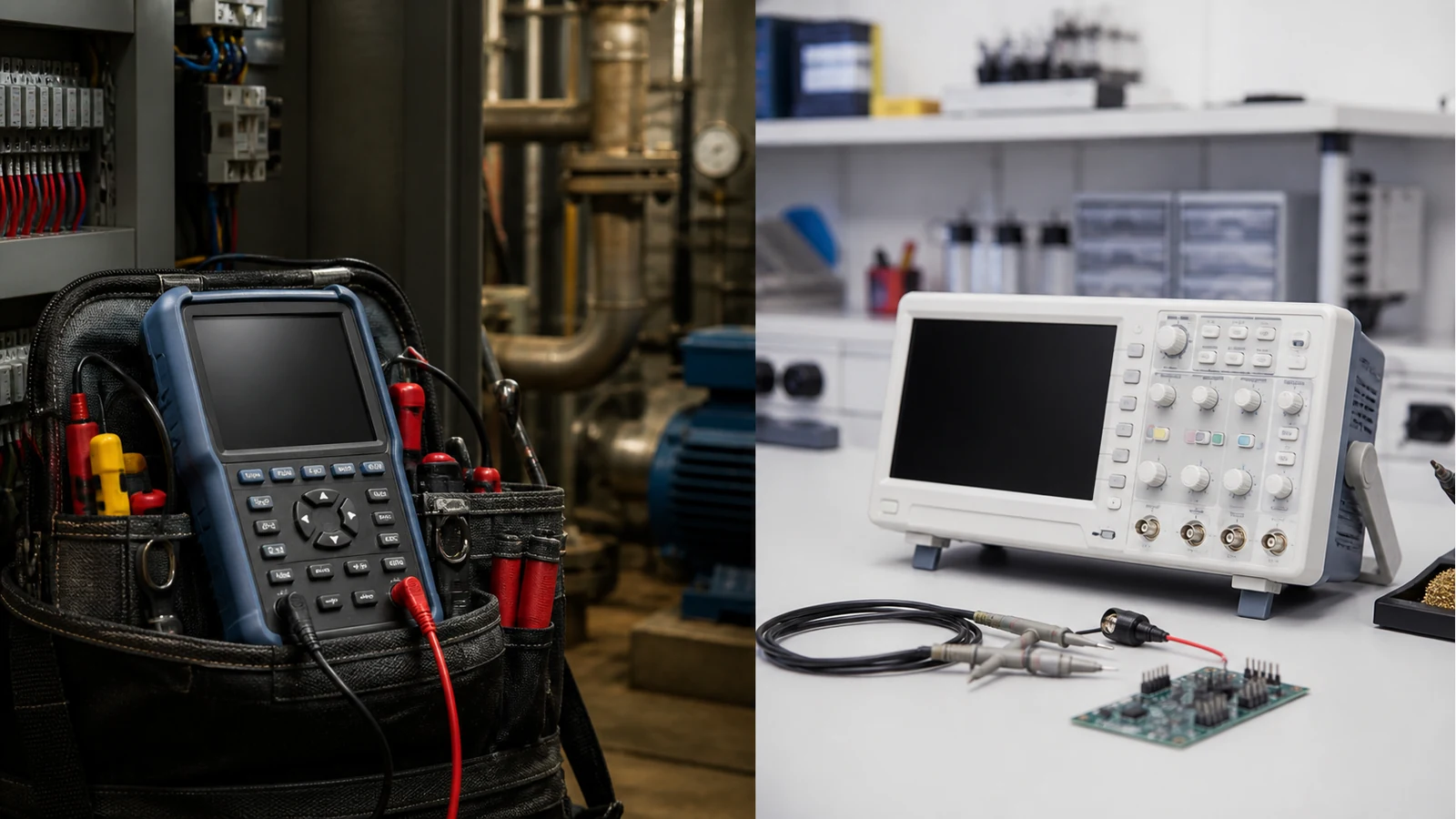
Handheld Vs Benchtop Oscilloscope Uk
Direct answer: choose a handheld oscilloscope when the measurement point moves around the site, the job happens in a van, plant room or customer premises, and you need a fast view of two signals without carrying a bench setup. Choose a benchtop oscilloscope when the work is mostly at a fixed bench, needs deeper analysis, larger displays, more channels or protocol-heavy debugging.
This is not really a “better tool” question. It is a fit question. Keysight's handheld oscilloscope guidance frames handheld scopes around field conditions and comparison points such as bandwidth, sample rate and memory depth. For UK engineers, the everyday constraint is often simpler: can the instrument get to the panel, vehicle or roof plant safely and quickly?
Where handheld wins
A handheld scope meter fits the jobs where an average DMM reading hides the fault: a sensor pulse dropping out, a PWM command changing duty cycle, a low-voltage control output arriving late, or a vehicle sensor correlation that only fails hot. Kunkune's handheld oscilloscope applications guide lists field uses across industrial, automotive and service work, which matches the sort of jobs where the test point is not near a clean bench.
| Buyer question | Handheld scope meter | Benchtop scope |
|---|---|---|
| Where is the fault? | Plant room, vehicle, customer site, mobile call-out | Workshop bench, lab, training bench |
| What matters most? | Portability, battery, quick setup, stored evidence | Screen size, deeper capture, controls, expansion |
| Typical channel need | Two related low-voltage signals | Two to four plus decoding or long captures |
| Safety question | Confirm input, probe and grounding limits before connecting | Confirm earth reference, probes and category limits before connecting |
Where benchtop still makes sense
A benchtop scope is still the comfortable choice for electronics development, repeat lab measurements, education benches and deeper waveform study. A public handheld versus benchtop comparison makes the same broad distinction: handheld for mobile troubleshooting, benchtop for lab-style analysis.
Do not buy a handheld just because the fault sounds urgent. If your normal work is high-speed digital design, several buses at once, detailed protocol decode or long memory captures, a bench or PC-based setup may be the more honest first purchase.
Proceed or pause?
Proceed with a handheld shortlist if you can name the two signals you need to compare on site, the expected voltage range, the reference point and how you will save the result. Pause if you cannot yet state the probe rating or whether the measurement point is earth-referenced or floating.
If your use case is a two-channel low-voltage field diagnostic workflow and the product page confirms the ratings and accessories you need, the handheld oscilloscope multimeter product page is a relevant same-site next check. Treat it as a fit check, not a substitute for the manual.